
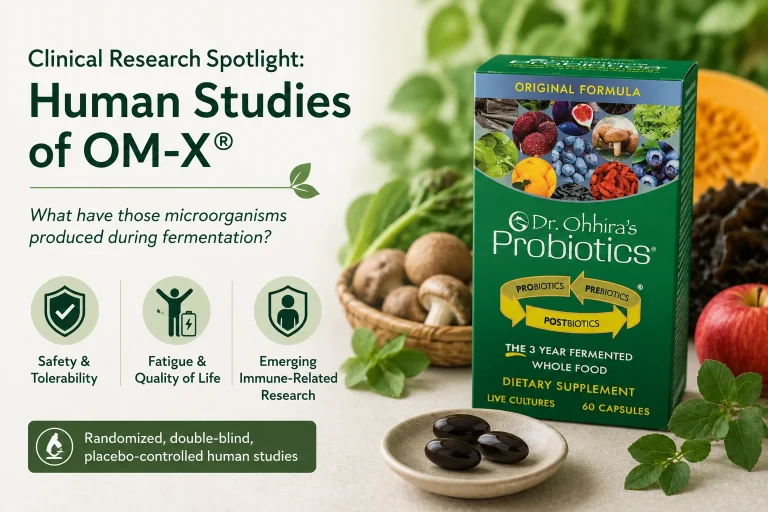
Clinical Research Spotlight:
Human Studies of OM-X Fermented Plant Extract
Clinical Research Spotlight: Human Studies of OM-X Fermented Plant Extract
The extended fermentation process used to produce OM-X has been evaluated in human clinical research, including randomized, double-blind, placebo-controlled studies. While the available trials are relatively small and should be interpreted accordingly, they provide useful clinical insight into the safety and potential physiological effects of this fermented food matrix.
Safety & Tolerability
A double-blind, placebo-controlled Phase I study evaluated the safety and tolerability of Dr. Ohhira’s OM-X capsules in healthy adults.
Study Design
Fifty healthy men and women were enrolled and assigned to receive either OM-X or placebo for 30 days. Participants took one capsule twice daily. Laboratory testing was performed at baseline and at the conclusion of the study, and adverse events were monitored throughout the trial.
Key Findings
Forty-six participants completed all laboratory and clinical assessments. No clinically significant laboratory abnormalities were identified during the study. Reported adverse events occurred with similar frequency in the active and placebo groups, were generally transient, and did not cause any participant to discontinue the trial.
Practitioner Perspective
Although this was a short-term study conducted in healthy adults, the findings provide controlled human data supporting the tolerability of OM-X under the conditions studied.
Spierings ELH, Walshe T, Pescatore F. Safety and tolerability of Dr Ohhira’s OM-X capsules in healthy volunteers. Integrative Medicine. 2013;12(5):38-42.
Fermentation, Fatigue & Quality of Life
A more recent randomized, placebo-controlled, double-blind trial examined OM-X in healthy adults experiencing temporary fatigue.
Study Design
Healthy Japanese adults between 40 and 59 years of age were randomized to receive three OM-X capsules daily or placebo for 12 weeks. Researchers assessed fatigue using a visual analog scale and the Chalder Fatigue Scale, along with measures related to oxidative status.
Key Findings
Compared with placebo, the OM-X group demonstrated statistically significant improvements in both the visual analog fatigue score and Chalder Fatigue Scale after 12 weeks. No adverse events attributable to the study product were reported.
The researchers concluded that continued intake of OM-X may help ameliorate feelings of temporary fatigue in otherwise healthy adults. Because the study population was small and limited to healthy adults with temporary fatigue, these findings should not be extrapolated to chronic fatigue or disease populations.
Kaneko T, Miyata A, Takahata M. Anti-fatigue effect of OM-X, fermented plant extract with lactic acid bacteria and bifidobacteria: A randomized, placebo-controlled, double-blind, comparative study. Journal of Functional Foods. 2022;97:105228.
Emerging Research: Immune-Related Quality of Life
A separate 12-week randomized, double-blind, placebo-controlled study evaluated OM-X in 39 healthy Japanese adults ages 40-59 who reported a tendency toward feeling unwell or experiencing cold-like symptoms.
Researchers assessed health-related quality of life using the SF-8 questionnaire along with a physical condition questionnaire. The investigators reported improvements in selected quality-of-life and self reported physical-condition measures in participants receiving OM-X.
These findings are preliminary and do not demonstrate that OM-X prevents or treats infectious or immune mediated disease. Rather, they add to the developing body of research examining how a complex fermented food matrix may influence measures of well-being in healthy individuals.
Kaneko T, Miyata A, Takahata M. Immunomodulating Effect of OM-X Fermented Plant Extract: A Randomized, Placebo-Controlled, Double-Blind, Comparative Study. Journal of Orthomolecular Medicine. 2023;38(1).
Connecting the Research to Postbiotic Metabolites
These studies evaluated OM-X as a whole fermented product, rather than isolating individual postbiotic metabolites. That distinction is important. The clinical findings cannot be attributed to one specific metabolite, probiotic strain, or component of the formulation.
Instead, the research provides an opportunity to consider the fermented matrix as a whole: probiotic microorganisms, residual food substrates, and compounds generated during fermentation are consumed together.
For practitioners, this is one of the more interesting aspects of extended fermentation. Rather than viewing a probiotic exclusively in terms of the number of microorganisms delivered per dose, emerging microbiome science invites a broader question:
What have those microorganisms produced during fermentation?
